The priest
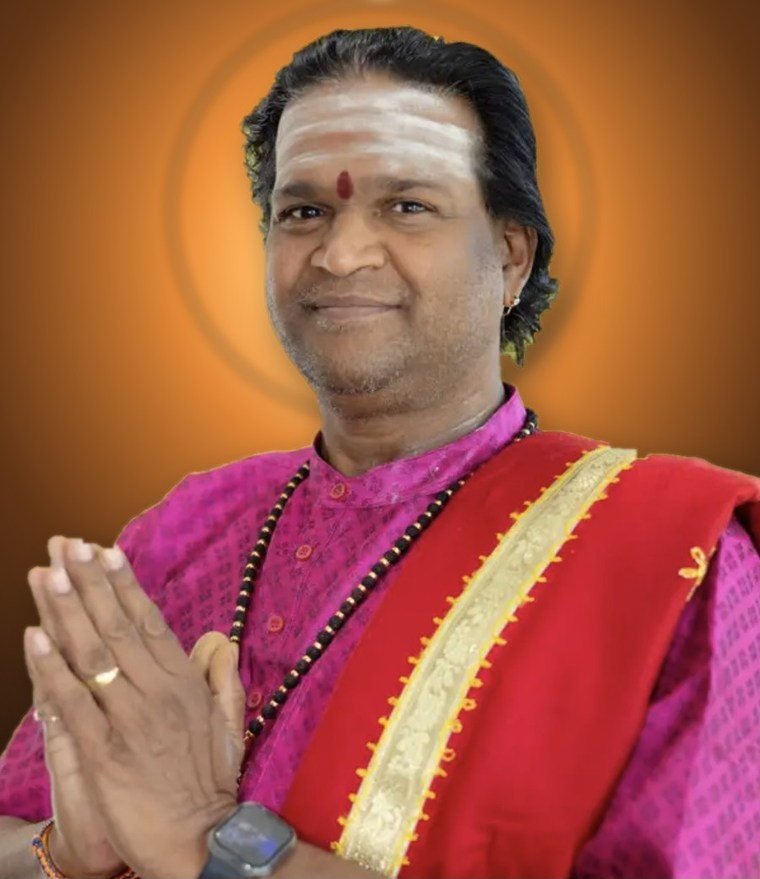
Sri Kumar Naganathan Gurukkal
Tamil Sivachariyar and Krishna Yajurvedi · San Francisco Bay Area
In short
Sri Kumar Naganathan Gurukkal is a Tamil Sivachariyar and Krishna Yajurvedi who has served Hindu families since 1990 — across India, Singapore and the United States, and in the San Francisco Bay Area since 2024. He was trained at the Sri Karpaga Vinayaka Vedāgama Vidhyalayam in Pillayarpatti, Tamil Nadu, India, studied under his guru Sri Pichai Sivachariyar, and belongs to the Ādi Śaiva Paramparā, a lineage his family has carried for at least seven generations. He performs weddings, homams, poojas and samskāras at your home, at a temple or venue, or with relatives joining online, in Tamil, Telugu, Hindi and English with mantras in Sanskrit. He does not perform funeral rites — antyeṣṭi, cremation or last rites; he does perform ancestral remembrance: Śrāddha, Tarpaṇam and the Pitṛ Pakṣa observances.
Names and titles
What families call him, and what the titles mean
Families write to him under several names, and all of them are correct. He is Sri Kumar Naganathan Gurukkal in full; most families say Sri Kumar Gurukkal or simply Kumar Gurukkal. Older directory listings sometimes carry Priest Kumar Naganathan Gurukkal. They all refer to the same priest.
The titles are not interchangeable, and the difference matters when you are looking for the right person for a ceremony:
Sivachariyar
A priest of the Ādi Śaiva lineage, trained in the Śaiva Āgamas and traditionally qualified to perform worship in Śiva temples as well as the domestic ceremonies of Śaiva families. Gurukkal is the everyday Tamil form of address for such a priest.
Krishna Yajurvedi
His Vedic śākhā — the recension of the Yajur Veda in which he was trained and which shapes the mantras he recites. It is a statement of training, not of sect.
Vedic and Āgamic priest
Two bodies of text govern Hindu ritual: the Vedas, and the Āgamas that set out temple and domestic ritual in detail. He is trained in both, which is what allows the same priest to perform a temple kumbhābhiṣekam and a family's housewarming.
Saiva priest
The English description families most often search for. It means a priest in the Śaiva tradition — the worship of Śiva and his family — which is the tradition this practice belongs to.
Training
Where he was trained
He was trained at the Sri Karpaga Vinayaka Vedāgama Vidhyalayam in Pillayarpatti, Tamil Nadu, India, in the disciplines of Sivāgama Rathnam, Vishesha Yogyatha, Veda Pandit and Agora Sivam. He undertook specialised study of the Agora Bhadathi section of the Karaṇa and Kāmika Āgamas (Yajur Veda) under his spiritual guru, Sri Pichai Sivachariyar.
Scriptural texts he recites from memory
Gaṇapati Upaniṣad · Śrī Rudram and Chamakam · Puruṣa Sūktam · Pañca Sūktigaḷ · Skanda and Śiva Purāṇas · Devī Māhātmyam · the Sahasranāmas · the Aṣṭottaras.
Guru and paramparā
A living lineage
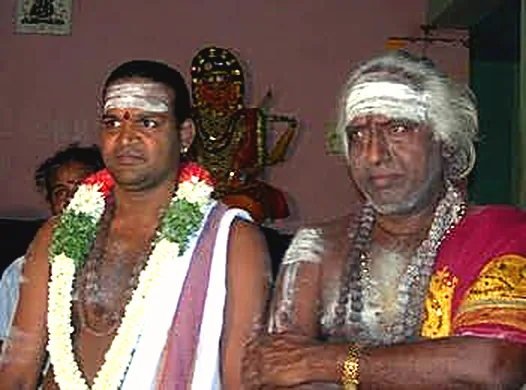
Sri Kumar Gurukkal belongs to the Ādi Śaiva Paramparā, the priestly lineage descending from the Nāyanmār saint Sundaramoorthy Swāmigal. His family recalls at least seven generations of Sivachariyars who served at the Sri Maragathavalli Chandrasekara Swami Temple, Sethur — one of the 108 temples of the Sivagangai Samasthānam, about 56 miles from Madurai.
He was trained in the tradition carried forward by Dr. K. Pichai Sivachariyar of Pillayarpatti, whose work in Vedic and Āgamic priestly education has received international recognition.
Service
The temples he has served
His priestly journey began at the Sri Bala Murugan Temple in Edaikattur, Tamil Nadu, and continued at the Sri Dharma Muneeswaran Temple in Singapore. Since 2004 he has held senior priestly roles at the Sri Murugan Temple of North America in Lanham, Maryland, and at the Hindu Temple of Greater Tulsa, Oklahoma. He has led Kumbhābhiṣekams — the consecration of a temple — at a number of temples, including the Iraivan Temple, Hawaii.
Independent practice. SaivaPriest.com is Sri Kumar Gurukkal's own practice. Temples named here describe where he has served; the site is not affiliated with, endorsed by or connected to any temple or its administering body.
Ceremonies
What he performs
Weddings (Vivāham) and engagements · Gṛha Praveśam and Bhūmi Pūjā · Nāmakaraṇam · Annaprāśanam · Chowlam · Karṇavedham · Seemantham · Upanayanam · Aksharābhyāsam · Āyuṣya Homam · Satyanārāyaṇa Pūjā · Gaṇapati, Navagraha, Rudra, Mṛtyuñjaya, Chaṇḍī, Sudarśana, Dhanvantari and Lakṣmī-Kubera homams · Vāstu Śānti · Vāhana Pūjā · business and Lakṣmī-Kubera pūjās · Śaṣṭiabdapūrti, Sathābhiṣekam and the milestone śāntis · Śrāddha, Tarpaṇam and Pitṛ Pakṣa · festival pūjās · muhūrtham, horoscope and Vāstu consultation.
This is not a closed list. Families keep different observances, and many have no common English name. If your family has a custom, a vratam or a prayer you would like performed, please ask.
What he does not perform. He does not perform funeral rites — antyeṣṭi, cremation or last rites. He does perform ancestral remembrance: Śrāddha, Tarpaṇam and the Pitṛ Pakṣa observances, which can be requested like any other ceremony. The two are often confused, and a family arranging one at short notice should not have to discover the difference at the wrong moment.
Languages
Which language your ceremony is in
Ceremonies are conducted in Tamil, Telugu, Hindi or English, with the mantras themselves in Sanskrit. Explanation as the ceremony proceeds — which is what most families actually want, and what younger family members need — is given in whichever of those four you prefer. Families following Kannada, Malayalam and other regional traditions are welcome to discuss their customs with him directly.
Service area
Where he serves
The San Francisco Bay Area: Pleasanton · Dublin · San Ramon · Livermore · Fremont · Milpitas · San Jose · Santa Clara · Sunnyvale, and surrounding communities.
Across Northern California: Sacramento · Stockton · Modesto · Santa Cruz · Monterey Bay. Further afield by arrangement — he has travelled for families before.
Ceremonies are performed at your home, at a temple or venue, or with relatives joining online by Zoom or WhatsApp where that suits the occasion.
Contact
How to reach him
Call or WhatsApp (240) 602-7327 or (510) 556-3434, or email gurukkalkumar@gmail.com.
A request is an enquiry, not a booking. Gurukkal reads it himself and replies personally to confirm the ceremony and the muhūrtham with you. Nothing is paid on this website.
Accuracy
Who is responsible for what is written here
The biographical facts on this page — training, lineage, temples served, languages and the list of ceremonies — are Sri Kumar Gurukkal's own, and he has reviewed them. Where this site describes ritual practice more generally it says whose tradition it is describing, because Hindu practice varies by sampradāya, region and family, and a website that flattens that is not being accurate.
If something here is wrong, please write to gurukkalkumar@gmail.com and it will be corrected.
Our editorial & ritual standards →
Reviewed by Sri Kumar Naganathan Gurukkal. Last reviewed: 20 August 2026.
Common questions
Questions families ask
Who is Sri Kumar Naganathan Gurukkal?
A Tamil Sivachariyar and Krishna Yajurvedi who has served Hindu families since 1990, across India, Singapore and the United States, and in the San Francisco Bay Area since 2024. He was trained at the Sri Karpaga Vinayaka Vedāgama Vidhyalayam in Pillayarpatti, Tamil Nadu, and belongs to the Ādi Śaiva Paramparā.
What is a Sivachariyar?
A priest of the Ādi Śaiva lineage, trained in the Śaiva Āgamas and traditionally qualified to perform worship in Śiva temples and the domestic ceremonies of Śaiva families. The training is in a specific body of ritual texts — the Āgamas — alongside the Vedas.
Which languages does he perform ceremonies in?
Tamil, Telugu, Hindi or English, with the mantras in Sanskrit.
Where does he serve?
Across the San Francisco Bay Area — Pleasanton, Dublin, San Ramon, Livermore, Fremont, Milpitas, San Jose, Santa Clara and Sunnyvale — and more widely across Northern California. At your home, at a temple or venue, or with relatives joining online.
Does he perform funeral rites?
No. He does not perform funeral rites — antyeṣṭi, cremation or last rites. He does perform ancestral remembrance: Śrāddha, Tarpaṇam and the Pitṛ Pakṣa observances.